

Most guides to airport advertising in the UK manage to say a great deal without actually telling you anything useful. They confirm that airports offer a captive, affluent audience. They quote a headline reach figure pulled from the airport’s own marketing materials. Then they ask you to fill in a form to find out what it actually costs.
First, the numbers that actually matter
UK airports collectively handled 302 million passenger journeys in 2025, a record year (Civil Aviation Authority). The raw reach is substantial. But that figure alone does not tell you why airport advertising deserves serious consideration.
UK passenger journeys (2025)
Heathrow passengers
Average terminal dwell
Dwell time
Passengers are waiting, browsing, eating, and killing time in a secure, contained environment, not rushing past a panel in two seconds.
Attention quality
In many locations mobile connectivity is inconsistent. Your ad is not competing with a phone screen in the same way it does everywhere else.
That dwell time is the single most important number in airport advertising, and the primary reason the format commands a premium over most other outdoor media.
Airport passengers are not rushing through. They have time they need to fill, and that receptiveness is a meaningful advantage you cannot replicate in most other outdoor environments.
Who actually uses UK airports? The audience question.
UK airport passengers skew meaningfully towards higher-income demographics. Research consistently puts the ABC1 proportion at between 65% and 75% across major hubs, with premium terminal audiences skewing higher still. But the airport audience is not uniform.
30-40%
Business travellers
Major hubs · weekday peaks
Senior decision-makers with above-average incomes. Early weekday morning departures and Thursday evening returns at hubs like Heathrow T5 are predominantly business traffic.
Leisure
Leisure passengers
Regional airports · holiday peaks
Dominate at most regional airports and during school holidays. Still above the national income average, relaxed, and often actively spending on retail, food, and travel accessories.
Airside
Departure lounge state
Post-security · highest receptiveness
Once through security they cannot leave and have time to fill. That psychological state is genuinely different from a commuter or retail shopper.
Terminal and route context tells you more than headline numbers
Heathrow Terminal 5 serves BA and partners on predominantly long-haul and premium European routes, materially different from Stansted's budget leisure European traffic. Edinburgh mixes business and domestic leisure. Birmingham combines package holidays with a Midlands business catchment. Luton is predominantly budget leisure. Plan the specific airport, terminal, and zone, not "airports" as a category.
Effective airport campaign planning starts with the specific audience you are trying to reach, and which airports, terminals, and departure zones actually put you in front of them.
Every format explained
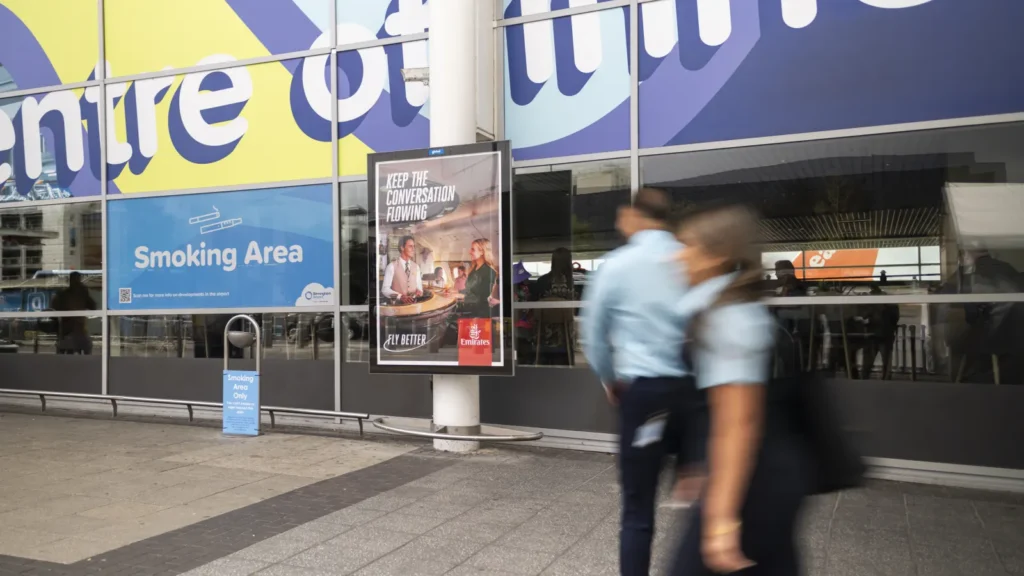
6-Sheet Static Posters
Backlit panels throughout the terminal: check-in, security queues, departure concourses, retail, and gate corridors. Always-on for the full campaign duration, visible 24 hours a day.
Regional
from £500 / panel
Mid-tier
from £900 / panel
Heathrow/Gatwick
from £1,800 / panel
Best for
Brand awareness and high-frequency exposure across multiple touchpoints in a single terminal.
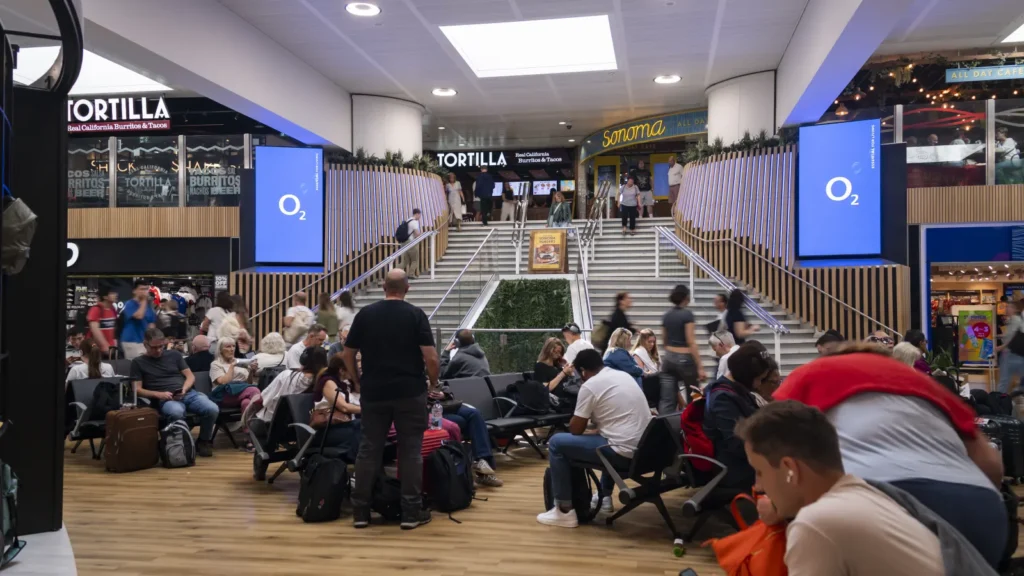
6-Sheet Digital Screens
Rotating digital ads on networked screens, typically five to eight advertisers per loop. Programmatic and daypart targeting at selected locations. No print cost; creative updateable remotely.
Regional
from £800 / week
Mid-tier
from £1,500 / week
Heathrow/Gatwick
from £3,200 / week
Best for
Scheduling flexibility, daypart targeting, or rapid creative changes.
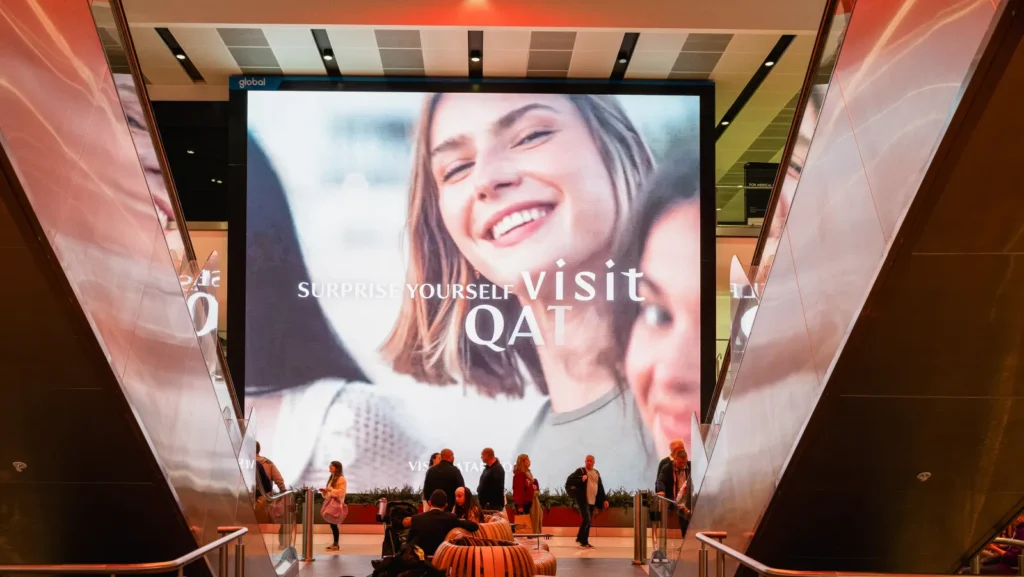
Large Format Digital
Full-motion screens at high-footfall locations: departure lounges, check-in halls, and retail concourses. Strongest engagement data in departure lounges; booked furthest in advance at premium airports.
Regional
from £2,000
Mid-tier
from £4,000
Heathrow/Gatwick
from £7,500
Best for
Brand campaigns and product launches where creative impact matters as much as reach.
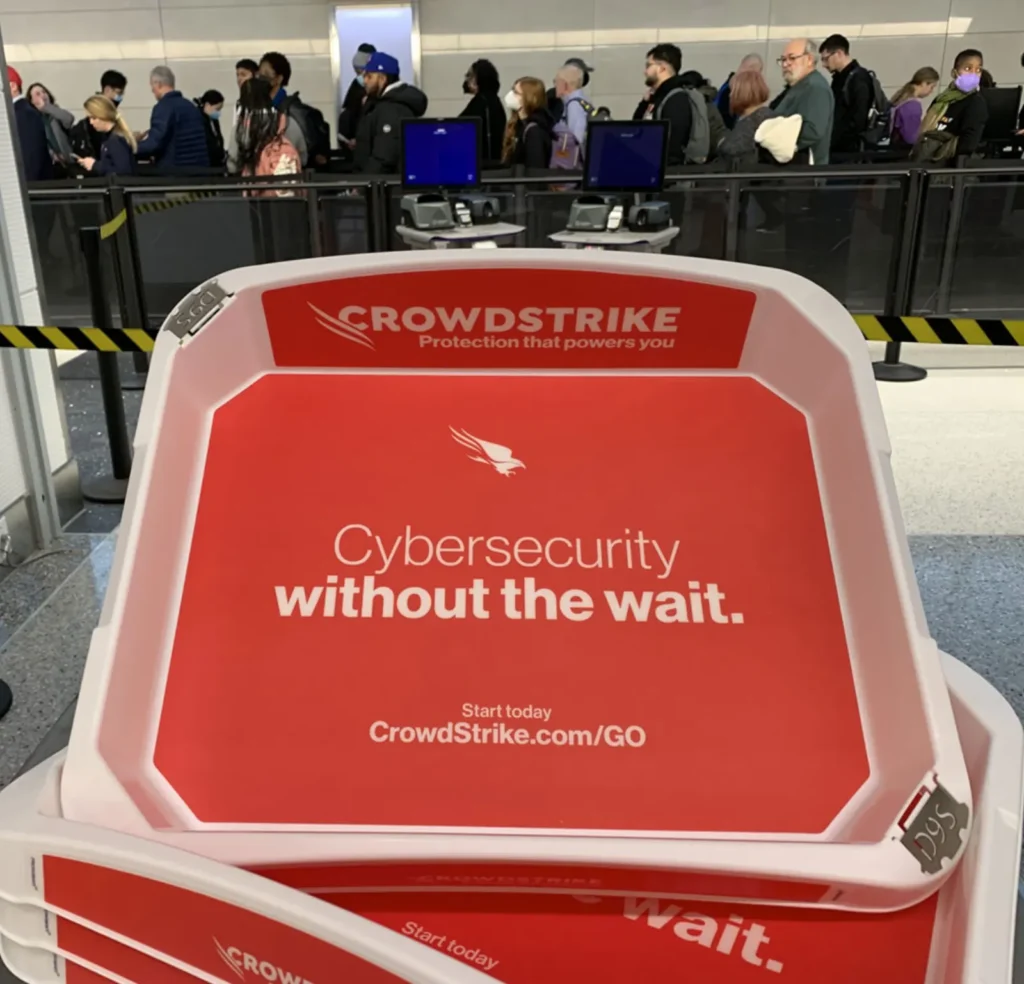
Security Tray Media
Branded insert panels inside the plastic trays at security screening. Every passenger handles the tray: intimate, unavoidable, and close-range. Selected Tier 1 and Tier 2 airports only.
Regional
Not available
Mid-tier
from £4,500
Heathrow/Gatwick
from £8,000
Best for
Brand recall, product launches, strong visual messages that work at tray scale.
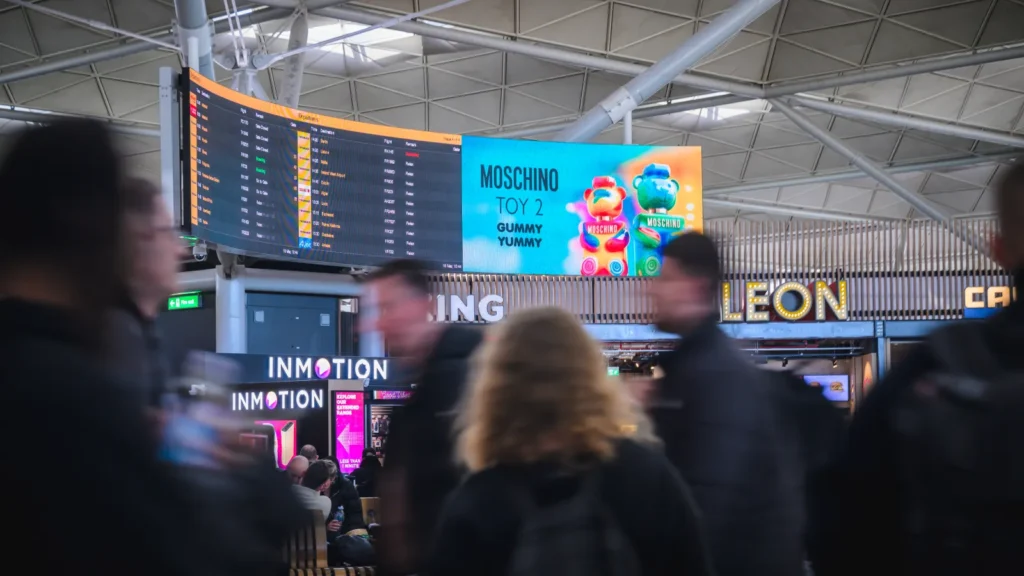
Departure Lounge & Gate
Full-motion screens at high-footfall locations: departure lounges, check-in halls, and retail concourses. Strongest engagement data in departure lounges; booked furthest in advance at premium airports.
Regional
from £2,000
Mid-tier
from £3,500
Heathrow/Gatwick
from £6,500
Best for
Reaching a confirmed, captive audience at the peak engagement point of the journey.
Baggage Reclaim
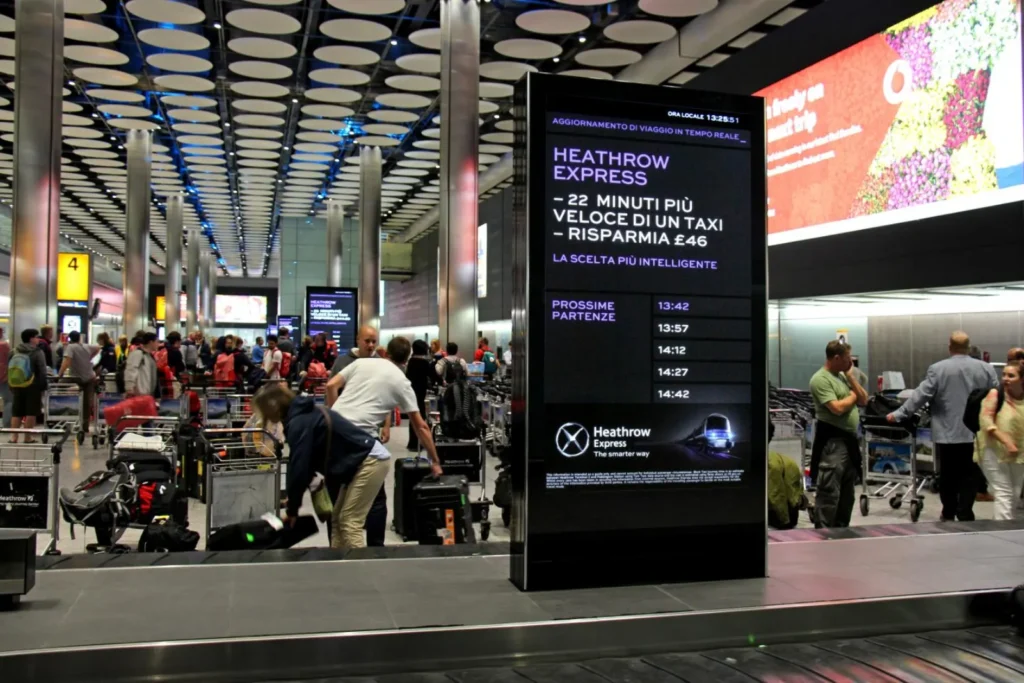
Posters, screen wraps, and panels at the carousel. Passengers wait 20-30 minutes stationary with limited distraction. It is one of the highest dwell-per-person fixed formats in the airport, and frequently overlooked.
Regional
from £3,500
Mid-tier
from £6,000
Heathrow/Gatwick
from £12,000
Best for
Hospitality, transport, car hire, and destination services targeting arrivals.
Arrivals Hall
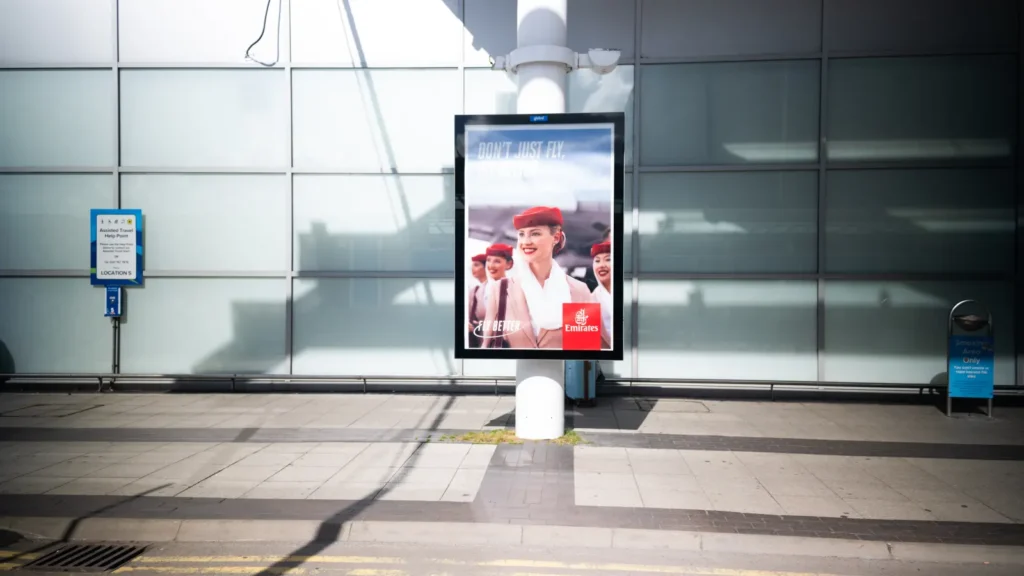
Static and digital formats in the public arrivals area, visible to arriving passengers and those waiting to meet them. Mixed audience of international arrivals and domestic greeters.
Regional
from £1,500
Mid-tier
from £3,000
Heathrow/Gatwick
from £5,500
Best for
Hospitality, transport, and consumer brands targeting those meeting international arrivals.
Terminal Dominations
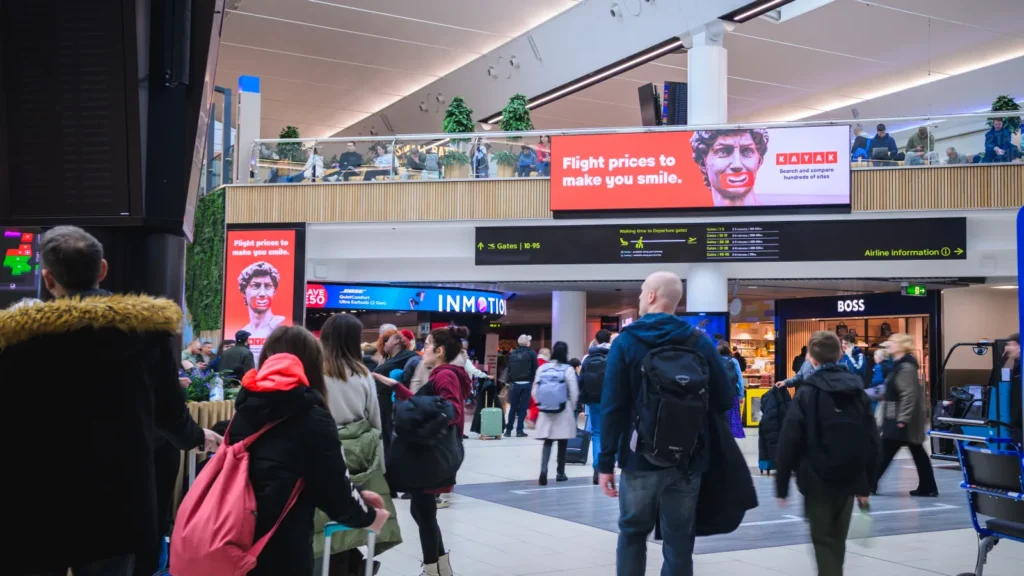
Total brand presence across all advertising surfaces within a single terminal. Dominations at major hubs reliably generate press coverage and social activity when the creative warrants it. Plan 8-12 weeks ahead.
Regional
from £20,000
Mid-tier
from £40,000
Heathrow/Gatwick
£80,000+
Best for
Major product launches, brand repositioning, campaigns where saturation is the strategy.
The 2026 rate card
Media cost only, excluding VAT and production. Two-week periods unless stated. Published openly, no mark-up.
Sort, filter, and compare every format in the table below. Regional (Tier 3), Mid-tier (Tier 2), and Heathrow/Gatwick (Tier 1). For all UK OOH formats, see the 2026 rate card.
| Format | Regional | Mid-tier | Hub (LHR/LGW) | Notes |
|---|---|---|---|---|
| 6-sheet static | £500 / panel | £900 / panel | £1,800 / panel | Always-on, full campaign duration |
| 6-sheet digital | £800 / week | £1,500 / week | £3,200 / week | 5-8 advertisers rotating per screen |
| Large format digital | £2,000 | £4,000 | £7,500 | Full motion. No print cost. |
| Security tray media | Not available | £4,500 | £8,000 | Selected airports only |
| Gate / departure lounge | £2,000 | £3,500 | £6,500 | Post-security, highest dwell zone |
| Baggage reclaim | £3,500 | £6,000 | £12,000 | 20-30 min dwell at carousel |
| Arrivals hall | £1,500 | £3,000 | £5,500 | Arrivals + greeters audience |
| Terminal domination | £20,000 | £40,000 | £80,000+ | 8-12 weeks lead time minimum |
| Roadside 48, approach | £450+ | TBC | £1,750+ | per panel / 2 wks |
Media cost only, excl. VAT and production. Source: our published rates.
What a real campaign looks like at different budget levels
Individual panel prices only tell you so much. Here is what airport advertising actually looks like across different total budgets.
Under £5,000
Entry
Entry point and proof of concept
A small number of 6-sheet static panels at a single regional airport, or a short digital rotation at a Tier 2 location. Enough to run a genuine airport campaign and understand how the format works, but not enough for meaningful reach or frequency. Treat it as a proof of concept.
£5k-£20k
Growth
Purposeful single-airport presence
Meaningful presence within a single terminal: departure lounge static posters with a digital rotation and possibly a gate position. A £10,000-£15,000 campaign at a well-chosen Tier 2 airport over two weeks generates genuine brand exposure with a defined, affluent audience.
£20k-£60k
Scale
Multi-format or multi-airport
Multiple formats across a single premium airport, or consistent presence across two or three regional airports. Combine static for sustained awareness with large format digital for creative impact, covering both departures and baggage reclaim.
£60k+
Domination
Domination territory
Terminal takeovers at major airports, multi-format campaigns across Tier 1 and Tier 2, or complete presence across both departure and arrivals at a premium hub. At this level the airport becomes a headline media environment and the campaign itself generates press coverage.
The factors that move the price
Five variables explain most of the difference between two otherwise similar campaigns.
Biggest lever
Airport tier
Heathrow typically costs two to four times the equivalent regional format. For brands that do not specifically need Heathrow, Tier 2 and Tier 3 airports offer genuinely competitive audience quality at a significant cost reduction, often with better availability at shorter notice.
Location
Position in the journey
Departure lounge and gate advertising commands a premium over check-in hall placements because dwell time is higher. Baggage reclaim is one of the highest dwell-per-person fixed formats and is priced accordingly.
TIMING
Seasonality
July, August, and December peak sharply. Premium inventory in summer and at Christmas requires booking months in advance. January through March and late October to November tend to offer better availability and occasionally better rates.
Duration
Campaign length
Standard campaigns run two weeks. Longer commitments of four, eight, or twelve weeks reduce the per-week cost materially. If you know you want sustained airport presence, committing upfront consistently works out cheaper.
Total cost
Format type and production
Digital formats carry no print production cost, which on large format placements can represent 10-20% of total campaign spend. Always calculate total cost including production when comparing static and digital options.
Production rule: Always build print production into the total budget from the start. Static production typically adds 10-20% to total campaign cost.
Does it work? The honest answer on effectiveness.
Airport advertising consistently produces above-average recall compared to other outdoor formats. Published media-owner research (JCDecaux) puts recall rates at between 65% and 78% among passengers exposed, compared to typically below 40% for equivalent digital display.
Yes - if you are buying awareness with an affluent, captive audience
Full-motion large format digital in departure lounges achieves the highest engagement scores in our campaign experience, often three to four times the attention we see from roadside digital equivalents. It is brand-building, not direct response.
| Format | Primary audience | Avg exposure | Recall | Direct response? |
|---|---|---|---|---|
| 6-sheet static | Terminal passengers, all journey stages | Repeated pass-bys | Moderate to high | No |
| 6-sheet digital | Terminal passengers, dayparted | Loop share (5-8 ads) | Moderate to high | Limited |
| Large format digital | Departure lounge / check-in / retail | Extended dwell | High | Limited |
| Security tray media | Every screened passenger | Close-range handling | High | No |
| Gate / departure lounge | Airside captive passengers | 30-60 min pre-board | High | Limited (QR viable) |
| Baggage reclaim | Arriving passengers | 20-30 min at carousel | High | Limited |
| Arrivals hall | Arrivals + greeters | Short to medium | Moderate to high | Limited |
| Terminal domination | Full terminal audience | Saturation | Very high | Limited |
Where it's strongest
Awareness and consideration with an affluent, captive audience. Extended dwell, limited phone competition in many zones, and a premium environment that reinforces brand positioning. Departure lounge digital leads engagement scores.
What it doesn't do well
Direct, trackable response as the primary metric. Hyper-local targeting below city level. Short timelines. Get the expectation right (awareness and consideration, not performance marketing) and the format consistently delivers.
Airport advertising is one of the most effective brand-building formats in the UK outdoor landscape when you are clear about what you are actually buying.
Choosing the right UK airport: a practical framework
Match the airport to your audience, not just the largest passenger number.
UK business decision-makers
Heathrow Terminal 5, Gatwick North Terminal, Manchester, and Edinburgh carry the highest business concentration. Early weekday morning departures and Thursday evening returns are the peak windows.
Reach at controlled budget
Manchester, Stansted, and Edinburgh together handle over 78 million passengers annually at significantly lower prices than Heathrow or Gatwick, and represent the strongest value in the mid-tier market.
Leisure and consumer brands
Gatwick, Stansted, and Luton skew leisure. Gatwick for mixed European leisure; Stansted and Luton for budget leisure and younger travellers at more efficient entry costs.
Regional SME entry
Birmingham, Bristol, Glasgow, Newcastle, and Leeds Bradford offer genuine local and regional reach at Tier 3 pricing, the most accessible airport entry for city-specific businesses.
Annual passengers by airport
2025 · CAA data · airports with meaningful commercial advertising inventory
/ European routes
and business
The booking process: what actually happens
Allow a minimum of four to six weeks from brief to live for standard static formats. Digital can sometimes move faster, but artwork approval takes three to five working days. Security tray media, gate advertising, and terminal dominations require eight to twelve weeks minimum.
Week 1 - Brief & airport plan
Airport and terminal selection, format mix, tier strategy, and rate confirmation.
Weeks 2-3 - Artwork & approval
Creative sign-off, CAP compliance, and airport operator content approval (3-5 working days).
Weeks 4-6 - Production & live
Print production and installation for static; digital can go live faster once approved.
JCDecaux holds the media rights at Heathrow, Gatwick, Stansted, Edinburgh, and Glasgow among others. Bauer Media Outdoor operates at several regional airports. Booking through an agency with established media owner relationships gives you access to availability not always visible to direct bookers.
Is airport advertising right for an SME?
Straight answer: Airport is a higher-commitment format than many alternatives. Entry costs are real, lead times are longer, and it is harder to adjust mid-campaign. But it is not exclusively a large-brand format. Smaller businesses with the right audience profile and a clear objective can make it work well at regional airports.
When it makes sense
- Your target customer travels regularly for business or leisure and airports are a natural part of their world
- You want to reach an affluent, professional audience with genuine dwell time and limited competing distractions
- Your creative is strong enough to justify a premium environment
- You are running alongside digital activity to capture the search interest the awareness campaign generates
- You have a specific regional focus and the relevant airport is a cost-effective access point.
When to think twice
- You need direct, trackable response rather than brand awareness
- Your target audience does not travel by air with any regularity
- Your budget does not allow for proper creative development alongside the media spend
- Your objective is hyper-local targeting below city level
- Your timeline is shorter than four to five weeks from brief to live.
How to get more from your airport advertising budget
Three well-chosen sites at the right location will consistently outperform ten poorly chosen ones.
Five planning moves that consistently improve what an airport budget delivers.
Targeting
Match format to where your audience actually is
A business-focused campaign should be in the departure lounge and gate areas at the right airports on early weekday departures, not in the check-in hall at a budget leisure airport.
Duration
Commit to longer campaigns when you can
Two-week campaigns are standard but frequently not optimal. A four or six-week campaign builds the repeated exposure that frequent business travellers specifically reward, and costs meaningfully less per week.
Overlooked
Do not overlook baggage reclaim
Exceptional dwell, captive audience, and competitively priced relative to departure-side inventory of equivalent quality. One of the most underused formats in UK airport advertising.
Measurement
Run digital search alongside airport activity
Airport advertising drives subsequent online search. Running paid search on branded and category queries alongside your airport campaign consistently improves measurable return. Airport does awareness; digital captures intent.
Creative
Build creative for the premium environment
Airport inventory sits in a high-quality physical context. Creative that looks thin or generic underperforms. Invest in work that earns the environment, especially on large format digital and terminal takeovers.
Frequently asked questions
How much does it cost to advertise at a UK airport?
Based on the Loud! OOH 2026 rate card, entry-level UK airport advertising starts from around £500 per 6-sheet panel at regional airports for a two-week campaign, rising to £7,500 and above per large format digital placement at Heathrow or Gatwick. A realistic first campaign for an SME wanting genuine visibility at one regional airport across two or three format types would typically cost between £5,000 and £12,000 for two weeks, including print production but excluding creative. See the full rate card on our airport advertising prices page.
Which UK airports are best for advertising?
It depends on your objective. For business decision-maker audiences, Heathrow Terminal 5, Manchester, and Gatwick North Terminal carry the strongest concentration. For maximum reach outside the Tier 1 price bracket, Manchester is the most efficient single-airport buy in the UK mid-tier market.
How long does it take to book a UK airport campaign?
Allow a minimum of four to six weeks from brief to live for standard static formats. Security tray media, gate advertising, and terminal dominations require eight to twelve weeks minimum. If you have a campaign date in mind, brief significantly earlier than you think you need to.
Can a small business afford to advertise at a UK airport?
Yes, with the right expectations. Entry-level campaigns at regional airports are achievable at budgets that many SMEs operate with. A focused £5,000 to £12,000 campaign at the right regional airport will consistently outperform a scattered budget spread thinly across multiple locations.
How do I measure whether it worked?
Brand tracking surveys before and after the campaign provide the most reliable measure of awareness impact. Monitoring branded search volume in Google Search Console during and after the campaign typically shows measurable uplift. QR codes and campaign-specific URLs work reasonably at departure lounge placements, though airport advertising is primarily an awareness format.
What content restrictions apply at UK airports?
The CAP Code applies to all UK airport advertising. Individual airports also have their own content policies going beyond the standard CAP rules. JCDecaux, which manages inventory at the major UK hubs, has its own approval process alongside the airport operator's requirements. Submit artwork for approval at least five working days before your campaign start date.
Final thoughts
UK airport advertising earns its premium. The audience is affluent, the dwell time is unmatched anywhere in the outdoor landscape, and the captive environment of a departure lounge gives your creative a quality of attention that almost no other format can offer.
The brands that get the most from airport advertising are clear about their audience, disciplined about which airports and formats genuinely put them in front of that audience, and rigorous about the quality of creative they take into a premium environment.
Does your audience pass through an airport regularly? If they do, airport advertising will reach them with a quality of attention that almost no other outdoor format matches.
At Loud! OOH we plan and buy airport advertising for SMEs and challenger brands across the UK. We publish pricing openly and do not mark up media costs. See our full UK OOH pricing or contact hello@loudooh.co.uk / 020 4514 9147.
Jamie Roberts
20 years in advertising, including six in out-of-home. Plans and buys airport, billboard, rail and taxi campaigns for SMEs and challenger brands across the UK.
Sources referenced in this article